If you've heard that "Tulum has no public beach anymore," I get it. Between 2023 and 2025, getting to the water here turned into a mess of fees, lines, and signs that contradicted each other. Here's the good news: that's over. Since late 2025 there are genuinely free public access points, and in July 2026 the fee structure got cleaned up even further. We're writing this guide from downtown Tulum, about 10 minutes from the sand by cab, and everything below is what's actually in effect as of August 2026.
This is the rundown: which beaches have real public access today, what costs money and what doesn't, and how to reach each one from town by bike, cab, or on foot.
What changed in 2025 and 2026
Quick context, because almost anything you read that's more than a year old no longer applies. When Jaguar Park (Parque del Jaguar) was created, the beaches along the ruins stretch ended up inside the park, and for a while the only way to set foot on that sand was to buy a ticket. There were complaints, press coverage, and plenty of travelers who turned around and went back to town without ever touching the ocean. We watched it happen daily.
In November 2025, the federal and Quintana Roo state governments opened two free public access points to the park's beaches, available 365 days a year to Mexicans and foreigners alike. New signage went up along the entire route, with signs that literally read "Public beach access, completely free." Two more free access points opened in the hotel zone at the same time, which we'll get to below.
In July 2026, under the Tulum Renace plan, park fees were restructured: Jaguar Park entry became free for Mexican nationals, the archaeological zone costs 80 pesos for Mexicans (free on Sundays for nationals), and foreign visitors pay for the park and the archaeological zone separately, a combined total of around 265 pesos, roughly 13 to 15 US dollars depending on the exchange rate. The internal electric shuttle runs 20 pesos per adult and 10 per child. Here's the part that matters: none of that applies if all you want is the beach and you walk or bike in through the public access points. The beach itself is free.
The public beaches inside Jaguar Park
There are five beaches with public access inside the park: Pescadores, Santa Fe, Playa Maya, Playa del Mangle, and El Faro. The two you'll actually head for are Pescadores and Santa Fe; the rest are smaller stretches you'll probably walk across without noticing. Playa Paraíso, the third beach in this guide, sits just past the ruins and is also free to reach on foot or by bike. One practical detail before you head out: the free access is pedestrian only. There's no parking lot, golf carts aren't allowed for the ride in, and it's about a 2-kilometer walk (a bit over a mile) from the entrance to the sand. Bikes are allowed, which is why riding from downtown is the smart play.
Playa Pescadores
This has always been the town's beach. The local fishermen still pull their boats up here, and the snorkel tours that cruise past the reef in front of the ruins leave from this stretch. It has the most local feel of the three: Tulum families on Sundays, coconut vendors, white sand, and water that's usually calm in the morning. Show up on a weekday before 10 a.m. and you'll have it nearly to yourself.
Playa Santa Fe
Right next to Pescadores, Santa Fe fully reopened to the public with the late-2025 changes. It's a wide band of sand with less boat traffic than its neighbor, which makes it the better spot to spread out a towel and stay a while. Don't expect services: bring water, sunscreen, and your own shade if you can, because the few free palapas go early.
Playa Paraíso
The classic Tulum postcard, directly below the ruins. It's still there and still gorgeous, but let's be straight with you: it's not the half-wild beach it was years ago. The beach club operating on that stretch works on a minimum-spend basis, and if you want to arrive by car, you have to go through the park system, with a reservation and whatever access fee applies to you. On foot or by bike through the public access, you get there without paying. If what you actually want is a lounger, an umbrella, and someone taking your drink order, skip the Paraíso logistics and compare options in our guide to the best beach clubs in Tulum, where we break down minimum spends and which ones are worth it.
The free hotel zone access points: Conchitas and Playa del Pueblo
Beyond the park, two public access points opened in the middle of the hotel zone in November 2025: Playa Conchitas at kilometer 4.5 of the coastal road, and Playa del Pueblo at kilometer 5.5. Both are free every day of the year, for residents, Mexicans, and foreign visitors, with no payment at any point. They're the logical choice if you want the hotel zone's more open stretch of sand without committing to a beach club's minimum spend. A golf cart is the comfortable way to move along the coastal road; here's how to rent a golf cart in Tulum without overpaying.
How to get there from downtown Tulum
All of this sits close to town. We're on Avenida Cobá, and these are the real-world times, not the brochure version:
| Beach or access | Where it is | From downtown | What you pay |
|---|---|---|---|
| Pescadores and Santa Fe | Jaguar Park, public pedestrian access | 10-15 min by bike or about 10 min by cab to the entrance, then a 20-minute walk | Nothing on foot or by bike |
| Playa Paraíso | Below the ruins, inside the park | 10-15 min by bike to the access; by car only through the park system | Nothing on foot; park access fee by car |
| Playa Conchitas | Km 4.5 of the coastal road | 10-15 min by cab or golf cart | Nothing |
| Playa del Pueblo | Km 5.5 of the coastal road | 10-15 min by cab or golf cart | Nothing |
| Archaeological zone + beach | Main park entrance, next to the Tren Maya station | About 10 min by bike from downtown | Archaeological zone ticket; park is free for Mexicans |
A bike gives you the most freedom here: the route is flat and you'll reach the park entrance in about fifteen minutes. If you didn't bring one, check our guide to renting a bike in Tulum. And if you're planning to stack the beach with cenotes or the ruins on the same day, our guide on getting to cenotes, ruins, and the beach from downtown has times and routes for every stop.
Sargassum in 2026: the honest version
We're not going to sell you the Instagram shot. 2026 is shaping up to be a very heavy sargassum year in the Caribbean, with the peak season running April through September. In August you might get a flawless turquoise morning or a brown carpet of seaweed at the waterline, and it flips from one day to the next. Public beaches show it more, because they don't have the constant cleanup crews the club stretches do. Before you pedal out there, ask how the water looks that morning or check our Tulum sargassum guide, where we cover the seasons, which beaches tend to escape it, and how to check conditions in near real time. And if it's a bad day, the cenotes near Tulum never have sargassum: Gran Cenote and Calavera are under 12 minutes from downtown by car.
Park rules and what to bring
Jaguar Park is a protected natural area, and the rules do get enforced:
- No single-use plastics: bring a refillable bottle.
- No drones, no smoking, no alcohol inside the park.
- Access is daytime only and the park closes in the late afternoon, so a slow sunset session is more of a hotel zone plan.
- Bring cash: coconuts, boat tours, and snacks out there don't take cards.
- Reef-safe sunscreen if you're getting in the water, the same kind you'd use at a cenote.
Where to stay if the beach is your plan
You won't be sleeping at the public beach: there are no hotels at Pescadores or Santa Fe. Your real options are the hotel zone, at hotel zone rates, or downtown, 10 minutes from the water at far more reasonable prices. If you want to compare areas properly, we have a guide on where to stay in Tulum.
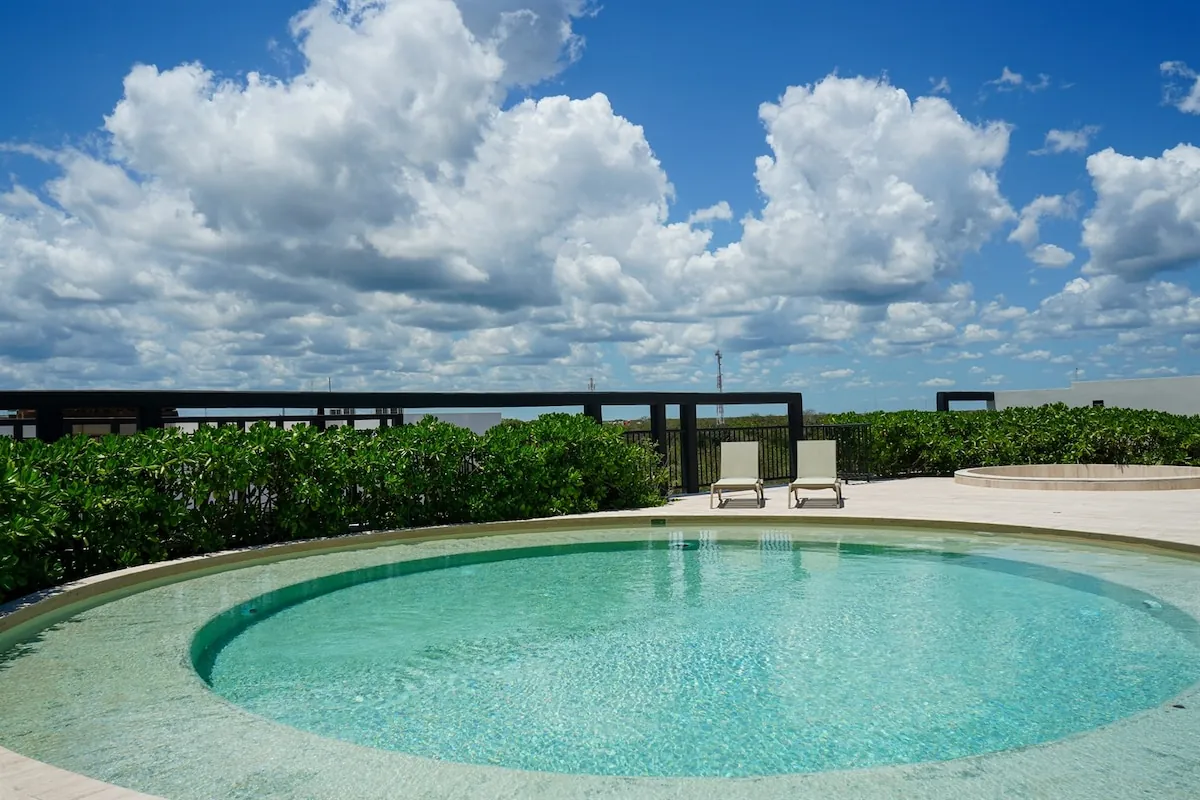
We rent out a two-bedroom apartment in downtown Tulum, right on Avenida Cobá: two bathrooms, a full kitchen so you're not eating every meal out, a pool, and a rooftop. From the front door to Pescadores is a 10-15 minute bike ride, and on the days sargassum wins, the pool saves the afternoon. It sleeps a family or two couples comfortably, and booking direct means skipping the platform fees; here's how direct booking without commissions works.
The short version: yes, Tulum has real public beaches, and they're better marked today than they've been in years. Go early, go by bike, carry cash and water, and check the sargassum before you head out. When the water here is clean, it doesn't need a filter.
Frequently Asked Questions
Which beaches in Tulum are public in 2026?
Inside Jaguar Park: Pescadores, Santa Fe, Playa Maya, Playa del Mangle, and El Faro, all reachable through free pedestrian access points; Playa Paraíso, right below the ruins, is also free to reach on foot or by bike. In the hotel zone there are two free public accesses: Playa Conchitas (km 4.5) and Playa del Pueblo (km 5.5), open every day of the year.
Is the beach free in Tulum?
Yes, if you walk or bike in through the public access points at Jaguar Park or in the hotel zone. You only pay if you drive into the park circuit or visit the archaeological zone, which has its own ticket; since July 2026, park entry is free for Mexican nationals.
How do I get to the public beaches from downtown Tulum?
By bike it's 10-15 minutes to the park access, then about a 20-minute walk to the sand; by cab the ride to the access takes around 10 minutes. Playa Conchitas and Playa del Pueblo are 10-15 minutes away along the coastal road.
Is Playa Paraíso still open to the public?
Yes. On foot or by bike you can reach it for free through the park's public access. By car you have to go through the park system, with a reservation and whatever access fee applies to you. The beach club on that stretch operates on a minimum spend.
Is there sargassum on Tulum's public beaches right now?
In 2026, yes, quite a lot: peak season runs April through September, and public beaches show it more because they don't have constant cleanup crews. It changes daily, so check how the water looks that morning before heading out.
What can't I bring into Jaguar Park?
No single-use plastics, drones, cigarettes, or alcohol. Access is daytime only, and almost nothing inside takes cards, so bring cash, a refillable water bottle, and reef-safe sunscreen.