Akumal is the day trip almost everyone staying in Tulum takes, and almost nobody understands before they go. It's 25 to 30 minutes north on Highway 307, the turtles live there year-round, and the activity has been federally regulated since 2016. That last part is what nobody tells you before you show up, and it's what decides whether your morning goes smoothly or expensively.
Why there are turtles in Akumal all year
Akumal means "place of turtles" in Maya, and for once the name isn't marketing. The bay is shallow, sheltered by a reef, and carpeted with seagrass. Seagrass is food. Green turtles and hawksbills don't pass through Akumal on the way somewhere else, they stay and graze, and loggerheads show up too. That's why your odds of seeing one are high on almost any day of the year, unlike places where sightings depend entirely on nesting season.
Since March 2016 the marine portion of the bay has been a federal refuge area for protected species, covering 1,653 hectares. In 2017 CONANP published a protection program with specific operating rules, and those rules are still the baseline for what a guide will ask of you today. The Centro Ecológico Akumal has monitored and protected the local turtles under government permit since 1993.
The rules that apply in 2026
Read these before you get on the colectivo. They save you an argument on the beach and, more to the point, a fine.
| Rule | How it works in practice |
|---|---|
| Authorized guide | Required to enter the swim circuits. Only operators licensed by SEMARNAT can run the activity. |
| Group size | Six people per guide, maximum. |
| Time in the water | Up to 55 minutes on circuit 1 and up to 65 on circuit 2. In practice most guides wrap up closer to 45. |
| Life vest | Mandatory. Not negotiable, and it also keeps you from dropping down onto the seagrass. |
| Distance | At least 3 meters from any turtle. No touching, feeding or chasing. |
| Sunscreen | Biodegradable only. Plenty of guides will just ask you to go in with nothing on and wear a rash guard. |
| Daily capacity | Federal authorities recommend a cap of 280 people per day in the activity. |
| Hours | 9:00 a.m. to 5:00 p.m. |
| Space between groups | 10 meters inside each circuit. |
The official minimum is 3 meters, but don't be surprised if your guide asks for more. And take the sunscreen rule seriously: show up covered in regular SPF and the guide can keep you out of the water. A long-sleeve rash guard solves it, covers you better anyway, and doesn't pollute.
The days there is no turtle swim
This is what wrecks the most plans. On Mondays the bay takes an ecological rest day and guided tours don't run. That's a co-op practice rather than a published schedule, so call the day before to confirm. And every September the activity is suspended as a conservation measure from CONANP and SEMARNAT, since it's one of the peak months for green turtle reproduction. It happened in September 2024 and again in September 2025. Pauses in February have been announced too, though that one isn't declared every year. If you're here in either month, keep a backup plan ready for that day.
Getting there from downtown Tulum
| Option | Time | Rough cost | Details |
|---|---|---|---|
| Colectivo (shared van) | 20-25 min | 35-40 pesos per person | Flag one on Avenida Tulum. They run every 10-15 minutes from 7 a.m. to 9 p.m. and drop you at the green stop on Highway 307, just before the pedestrian bridge. |
| Rental car | 25-30 min | Gas + 50 pesos parking | Easiest if you want to add a cenote on the way home. |
| Taxi | 25-30 min | Agreed before you get in | No meters here. Ask for both directions up front. |
| Organized tour from Tulum | Full day | Considerably more | Usually bundles Akumal with a cenote and the ruins. Zero logistics, but it eats the whole day. |
From the pedestrian bridge to the bay it's a 10 to 12 minute walk down a street covered in murals. Easy. Don't count on Uber or DiDi in Tulum; the app that actually works here is InDrive, where you name the fare. And since taxis have no meters, agree on the price before you get in. If you're renting a car for a few days, car rental in Tulum covers the insurance and deposit traps.
Guide or on your own? The honest answer
Two different things get mixed up here. One is the beach: it's federal land, walking in on the public path is free, and nobody can legally charge you to stand on the sand. The other is the turtle swim: it happens inside marked circuits over the seagrass, and that part requires an authorized guide.
So yes, you can go to Akumal, swim near shore and pay nothing. What you can't do is head out over the seagrass by yourself hunting for turtles. If someone at a booth asks for $20 or $25 just to walk onto the beach, that isn't an official fee, keep walking to the public access. And if a guy with no credentials offers to take you to the turtles for less, skip it. Guiding without a permit carries real penalties, and you're the one who ends up stranded mid-bay.
Full-day tours out of Tulum cost several times more and take the entire day. They make sense if you'd rather not think about any of this. If you're already staying downtown, going on your own and booking with the co-op on the beach is cheaper and gets you back for lunch.
What it costs in 2026
| Item | Rough 2026 price |
|---|---|
| Turtle swim with a local co-op | Around 650 pesos per person, including access, the CONANP fee, gear and guide |
| Parking | 50 pesos, no time limit |
| Colectivo round trip from Tulum | 70-80 pesos per person |
| Beach access via the public path | Free |
| Mask and snorkel rented on their own | Around 100 pesos |
The co-op price has climbed: about 450 pesos in 2022, roughly 600 in 2025, and in July 2026 Akumal's own service providers were quoting around 650 per person with everything included. Bring cash in pesos, since a lot of booths don't take cards.
If sharing a mask bothers you, bring your own from town. We cover what's worth renting and what's worth buying in snorkel gear rental in Tulum.
How the tour actually goes
- You walk in through the public access and out to the sand. The co-op booths are right there.
- You book, pay, and get a life vest, mask and snorkel. Hang on to your receipt.
- They put you in a group of no more than six with one guide.
- Short briefing at the water's edge: no touching, no chasing, no standing on the seagrass.
- You walk in and swim out to the circuit. The vest keeps you on the surface, which is also the best angle for watching a turtle graze below you.
- Forty-five to sixty minutes in the water, then back. With waiting time, budget about two hours at the bay.
There are no proper changing rooms or lockers on the public beach. Show up already in your swimsuit and carry as little as possible.
What time to go, and what you'll actually find
The activity opens at 9 a.m. The first groups get the calmest water and the best visibility. Buses from Cancún and Playa del Carmen start rolling in around 10 and the bay changes character from there.
Now the honest part: Akumal is not a secret beach or an intimate experience. It's a bay with more than twenty co-ops working it, dozens of groups in the water, and a wait for your turn in high season. The recommended 280-person daily cap helps, but that's still a lot of people in a small space. You will almost certainly see turtles, and you will also see orange life vests everywhere. If you were picturing silence and a turtle to yourself, that place doesn't exist on this coast anymore.
One thing working in your favor this year: in July 2026 Akumal operators reported visitor numbers at just 35 to 40 percent of normal, thanks to the combination of sargassum and low season. Fewer people in the water.
Sargassum and how it's hitting Akumal this year
Akumal isn't spared from sargassum either, and this year has been heavy. The difference here is that 22 co-ops with roughly 150 people clean nearly a kilometer of beach every day, with machinery loaned by a hotel in the area. There have been mornings when the bay was buried at dawn and clear again by afternoon.
Before you leave, check the day's report from the Quintana Roo sargassum monitoring network. If it looks bad, change the plan without drama. How to read it and what to expect month by month is in sargassum in Tulum: the real season.
If it's closed, packed, or full of sargassum
- Yal-Kú Lagoon, a few minutes north of the bay. It's an inlet where fresh water mixes with salt water, with plenty of fish and calm water even when the ocean is rough. Open 9 a.m. to 5 p.m. seven days a week, life vest required, no chemical sunscreen allowed, and there's an entrance fee. Two ticket booths charge different rates, so check the current price on yalkupark.com before you go. No turtles guaranteed.
- Half Moon Bay, right next to the main bay. Shore snorkeling and far fewer people. La Buena Vida, the beach restaurant there, is still open seven days a week.
- Cenotes. When the ocean doesn't cooperate, fresh water always does, and several sit 10 to 15 minutes from downtown Tulum: the best cenotes near Tulum.
- Beaches in town. Which public access points are worth it and what to expect at each is in public beaches in Tulum.
What to bring
- Cash in pesos. Several co-ops don't take cards.
- A long-sleeve rash guard instead of sunscreen. It's the path of least resistance.
- Water and a snack if you go early.
- A towel and dry clothes for the colectivo home.
- No long fins in the shallows and no drones.
The full packing list by season is in what to pack for Tulum.
Where to stay so Akumal isn't a rush
Akumal works when you start early, and you start early when you sleep near where the colectivos run. Northbound vans are flagged on Avenida Tulum, right downtown. From our two-bedroom apartment in downtown Tulum that's a 5 minute walk: out the door at 8:15, in the bay at 9:00 with the first groups, back in time for lunch.
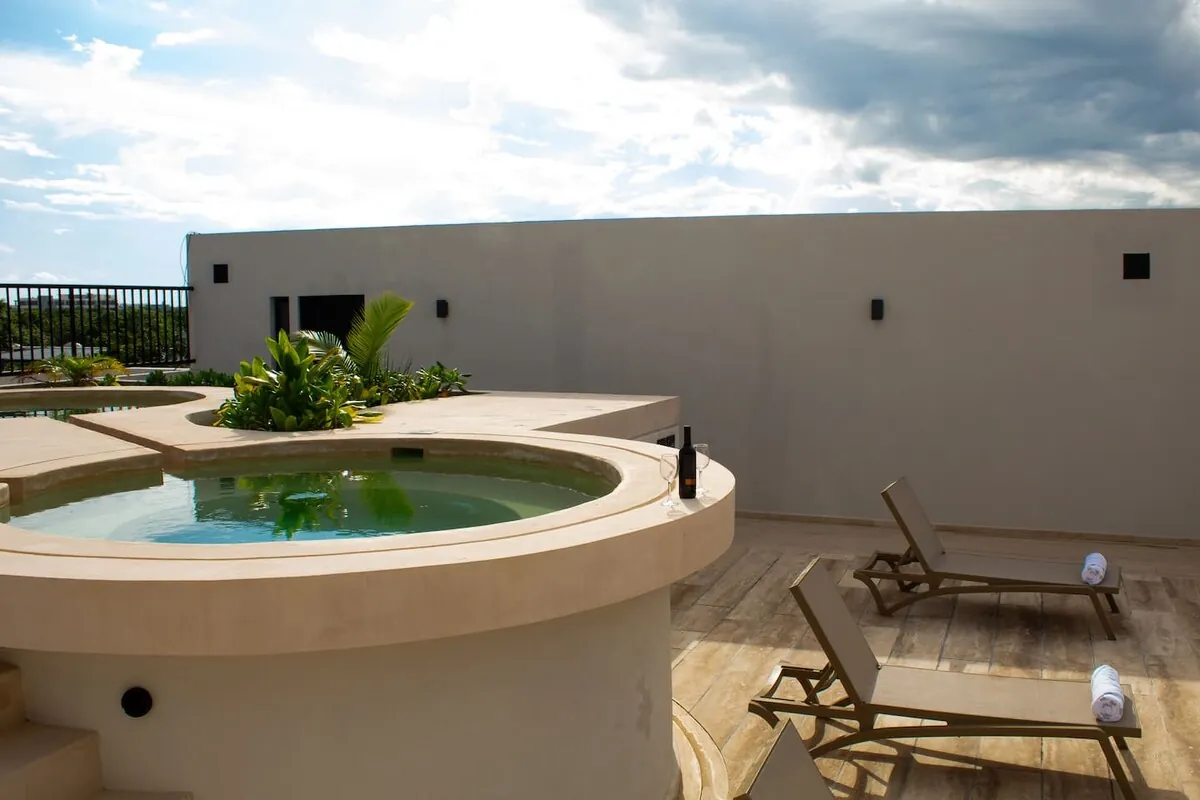
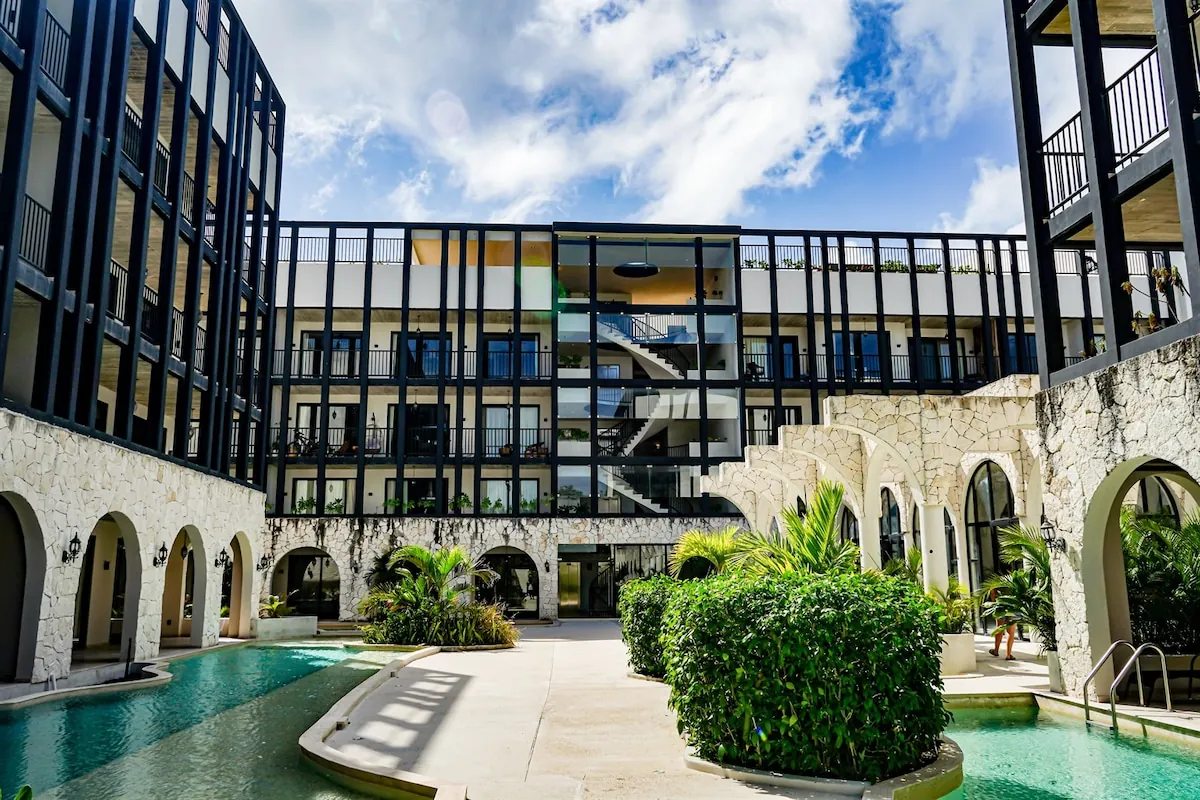
It's a two-bedroom, two-bathroom apartment with a full kitchen, a pool and a rooftop. On a day like this the boring stuff is what matters: rinsing swimsuits and hanging them up, water chilling from the night before, breakfast at 7:30 without waiting on a hotel buffet, and two bathrooms when four people are trying to leave at the same time. If you're weighing formats, apartment vs. hotel in Tulum lays it out plainly. And if you want Akumal to fit into a longer trip, the 3, 5 and 7 day Tulum itinerary already places it so it doesn't land on a Monday.
Frequently Asked Questions
How much does it cost to swim with turtles in Akumal in 2026?
With the local co-ops it runs around 650 pesos per person, and that includes access, the CONANP fee, snorkel gear, life vest and guide. Add 50 pesos for parking if you drive, or 70-80 pesos for a round-trip colectivo from downtown Tulum. Bring cash in pesos, since many booths don't take cards.
Can you swim with turtles in Akumal without a guide?
The beach is federal land and walking in through the public access is free, so you can swim near shore without paying anyone. What you can't do is enter the marked circuits over the seagrass on your own, which is where the turtles are. Federal rules require a SEMARNAT-authorized guide, groups of six people maximum, and a life vest.
Which days is the Akumal turtle swim closed?
Mondays are an ecological rest day and guided tours don't run. September is suspended outright under CONANP and SEMARNAT conservation measures, as happened in 2024 and 2025. February pauses have been announced too, though not every year. Neither date lives on an official published calendar, so confirm with the co-op before you leave town.
How do I get to Akumal from downtown Tulum without a car?
Take a colectivo. You flag them on Avenida Tulum, they run every 10 to 15 minutes from 7 a.m. to 9 p.m., and the fare is 35 to 40 pesos. The ride is 20 to 25 minutes and drops you at the green stop on Highway 307, just before the pedestrian bridge. From there it's a 10 to 12 minute walk to the bay.
What's the best time of day to arrive in Akumal?
Right at 9 a.m., when the activity opens. The first groups get the calmest water and the best visibility. Buses from Cancún and Playa del Carmen start arriving around 10 and the bay fills up fast.
Does sargassum ruin Akumal?
It can complicate things. 2026 is a record sargassum year and the season runs April through September, but 22 co-ops with about 150 people clean nearly a kilometer of Akumal beach daily, so the bay bounces back quickly. Check the Quintana Roo sargassum monitoring report the morning you go and keep a cenote as your backup plan.