Chichén Itzá sits about 150 kilometers (93 miles) from downtown Tulum. Your map app says two hours. Your map app is optimistic. Plan on 2 to 2.5 hours, because the good road runs through small towns, has speed bumps where you least expect them, and there is almost always a semi truck in front of you.
Can you do it as a day trip? Yes, and most people staying in Tulum do. What decides whether the day goes well or turns into an expensive, sweaty slog is what time you leave town. Below is everything as of August 2026, including the two big changes this year: the single ticket and the new CATVI entrance.
Real distance and driving time from downtown Tulum
The natural route does not go through Cancún. You leave town on the Cobá road, continue toward Chemax, cross into Yucatán state, and pick up Highway 180 to Pisté, the village right next to the ruins. It is a free two-lane road, no tolls if you go this way.
- Straight through, no stops: 2 to 2.5 hours.
- With breakfast or a Valladolid stop: a solid 3 hours.
- Full day, door to door: 10 to 12 hours.
Leave at 6:00 or 6:30 a.m. and you reach the ticket window right as it opens. That is the single most useful piece of advice on this page, and it costs nothing.
Four ways to get there, side by side
| Option | Rough cost | Door-to-door day | Best if |
|---|---|---|---|
| Rental car | Daily rate plus gas, split among everyone | 10-11 h | Two or more of you and you want to be at the gate at 8:00 |
| Organized tour | From ~$35 USD transport only; $90-120 with entry, cenote and lunch | 10-12 h | You do not want to drive or plan anything |
| ADO bus | Roughly 270-400 MXN each way | ~11 h, on a fixed schedule | You are solo and fine arriving mid-morning |
| Maya Train | Requires a transfer | Timing does not work: you arrive after closing | Almost never, from Tulum |
Rental car: the only way to control your day
It is the only option that gets you to the gate at 8:00 sharp, when the site is cool, nearly empty, and the light is actually good for photos. It also lets you decide on the fly whether to loop back through Valladolid or stop at a cenote. Official parking runs 124 MXN for a private car, and CATVI has 517 spaces. Show up at 8:00 and you'll park without thinking about it; by mid-morning in high season, with the coaches already in, it gets tight.
Two driving notes. There are stretches on the Cobá road with no cell signal, and you will be coming back into Tulum after dark on a federal highway full of poorly lit speed bumps. If you have never driven the peninsula at night, head back earlier. You can compare options and rates on our car rental in Tulum page.
Organized tour: easy, but you arrive late
Tours from Tulum pull out between 8:20 and 8:50 a.m. That puts you at the ruins around 11:00, exactly when the sun is brutal and the big coaches from Cancún and Playa del Carmen have already unloaded. That is the real cost of a tour. Not the money, the timing.
In exchange you get door-to-door transport, a guide, and usually the Ik Kil cenote plus a Valladolid stop bundled in. With four people the math often lands close to renting a car, with the difference that nobody has to drive home in the dark.
ADO bus: cheap and direct, but there is only one bus back
There is a direct Tulum-Chichén Itzá run. It leaves the downtown terminal in the morning, somewhere between 9:00 and 9:40 depending on the season, and takes about 2 hours 20 minutes. The part that matters is the return: it departs Chichén Itzá mid-afternoon, between 16:00 and 16:30, and it is essentially the only one. Miss it and your plan B is a colectivo or taxi to Valladolid and a bus from there.
Buy ahead at ado.com.mx or at the terminal. Same-day fares jump a lot, and buses fill up in high season. Check the schedule for your specific date, since it shifts through the year.
Maya Train: not from Tulum
The Chichén Itzá station is real, sits in Pisté about 3 km from the entrance, and works fine. The problem is network geography. There is no direct service from Tulum. You would ride north to Cancún airport and transfer onto the corridor that runs to Valladolid, Chichén Itzá, Izamal and Mérida. Between waiting and transferring, you burn more than half a day each way. The train is genuinely useful for other trips, and we break that down in our Maya Train from Tulum guide.
2026 admission: the new single ticket
This is the biggest change of the year. Until April you paid two separate tickets, one to INAH and one to the state of Yucatán, at two different windows. Since April 27, 2026, the Boleto Único INAH-AAFY is in effect: one line, one charge.
| Visitor | 2026 price |
|---|---|
| Foreign visitor | 697 MXN |
| Mexican national or foreign resident of Mexico | 310 MXN |
| Yucatán resident with state ID or license | Free through 2026 |
| Under 13, over 60 with INAPAM, students and teachers with valid ID | Free |
| Sundays, Mexicans and residents | Free |
| Parking, private vehicle | 124 MXN |
Yes, it went up, and not by a little. Chichén Itzá now carries some of the highest archaeological site fees in Mexico, and there is no discount for showing up late or staying an hour.
Certified guides wait at the entrance and charge roughly 900 to 1,800 MXN per group of up to ten, depending on language and tour length. With four or more people it is worth it. Without the narration, a good chunk of the site reads as attractive stonework with no context.
One practical note about Sundays: entry is free for Mexicans and residents, which makes it the busiest day at the busiest archaeological site in the country. Skip Sunday if you can.
Hours, and what time to actually show up
Current hours are 8:00 a.m. to 4:00 p.m., with last entry at 3:00 p.m. You will still find agency pages advertising a 5:00 p.m. close, so confirm before you drive out. And to be clear, 3:00 p.m. is the cutoff to get in, not a sensible arrival time.
- 8:00 to 9:30: the golden window. Cool, quiet, long shadows, and many craft stalls not open yet.
- 10:30 to 1:00: the coaches from Cancún and the Riviera Maya land. Peak heat, lines at the main structures, people in every photo.
- After 2:00: crowds thin a little, but the heat does not, and you are short on time before closing.
To walk the main structures without rushing, budget 2.5 to 3.5 hours.
What the photos leave out: heat, crowds and vendors
Chichén Itzá closed 2025 with 2,182,034 visitors, nearly 60% of them international. It is the most visited archaeological site in Mexico, and it feels like it.
There are 666 authorized vendors operating inside the complex. The causeway running from the Sacred Cenote to El Castillo is lined with craft stalls, and you will not walk a hundred meters without being offered something. This is not a scam or a safety issue. It is how the site works and how the surrounding communities make a living. Arriving at 8:00 helps, since many stalls open later.
Since March 2026, entry is only through CATVI, the new visitor center on Highway 180 north of the pyramid. It covers 16 hectares with new ticket windows, larger restrooms and the main parking lot. The old parador entrance is no longer in use.
And one warning almost no guide gives you: in May 2026 the site was closed for 13 days, from May 19 to June 1, over a dispute with vendors who refused to relocate to the new craft market. It was settled and the site reopened, but this kind of thing can recur. Before you drive two and a half hours from Tulum at six in the morning, check that it is open.
A few more realities. You cannot climb El Castillo, that has been banned for years. You cannot swim in the Sacred Cenote. And there is very little shade. Bring water, a hat, reef-safe sunscreen and closed shoes. Full list in what to pack for Tulum.
What to combine on the same trip
Ik Kil cenote. Three kilometers from the ruins, open 9:00 a.m. to 5:00 p.m., basic entry around 180-250 MXN depending on the package. It is the most photographed cenote in Yucatán, the one with vines dropping from the rim. It is also the most crowded: mandatory life vests, a line for the stairs, and by mid-afternoon more people than water. As a stop along the way, it delivers. If what you actually want is a quiet swim, there are better options fifteen minutes from your place in Tulum, compared in our guide to the best cenotes near Tulum.
Valladolid. It is 45 km from Chichén Itzá, about 40 minutes, and sits directly on your way back to Tulum. Colonial town, quiet streets, and you can walk the Calzada de los Frailes to the San Bernardino de Siena convent, eat well, and swim at Cenote Zací, ten minutes on foot from the main square and barely thirty pesos. An afternoon in Valladolid is the best way to keep the return leg from being pure windshield time.
Chichén Itzá or Cobá? Which one makes sense from Tulum
This is the real question if you are based downtown, because Cobá is 47 km and 45 minutes away, not two and a half hours.
| Chichén Itzá | Cobá | |
|---|---|---|
| From downtown Tulum | ~150 km, 2-2.5 h | ~47 km, 45 min |
| 2026 entry | 697 MXN foreign / 310 MXN national | 210 MXN foreign / 105 MXN national, plus local fees |
| Hours | 8:00-16:00, last entry 15:00 | 8:00-17:00, last entry 16:00 |
| Can you climb? | No | Yes, Nohoch Mul, 8:00 to 15:30 |
| Feel | Open plazas, big crowds, many vendors | Jungle, shade, bikes, fewer people |
| Full day? | Yes, 10-12 h | No, a half morning |
Cobá reopened the Nohoch Mul climb on December 7, 2025, after six years closed, now with a wooden staircase and groups of fifteen. Climbing an actual Maya pyramid with jungle to the horizon is something Chichén Itzá simply no longer offers.
Honest call: with five nights or more in Tulum, do both, on separate days. With three nights and one free morning, Cobá gives you more for less effort and leaves the afternoon for the beach. Chichén Itzá earns the day when it is your first time on the peninsula and you want to see the headline site. Details in Cobá ruins from Tulum, and if you want to see how it all fits into your days, check the 3, 5 and 7-day Tulum itinerary.
Where to stay in Tulum so this day does not wreck your trip
A Chichén Itzá day starts at six in the morning and ends after seven at night. Anything that saves you time at either end of that day matters more than you'd think.
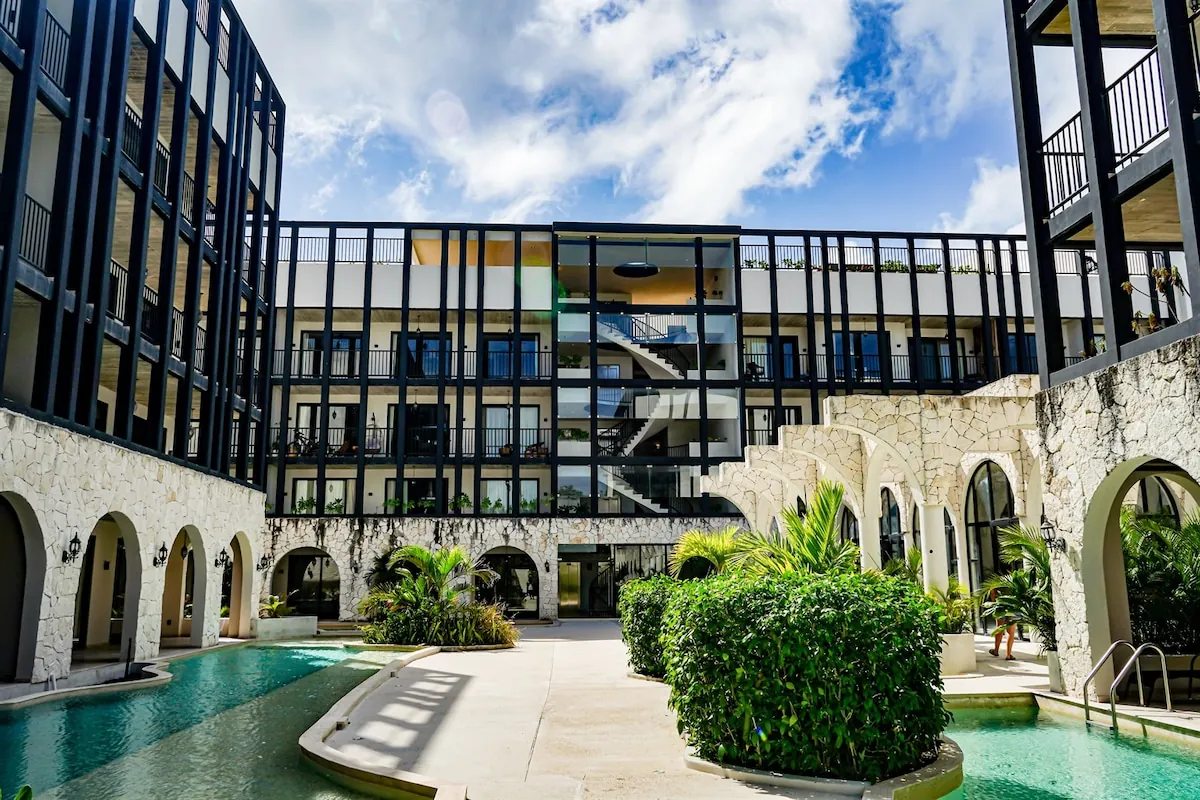
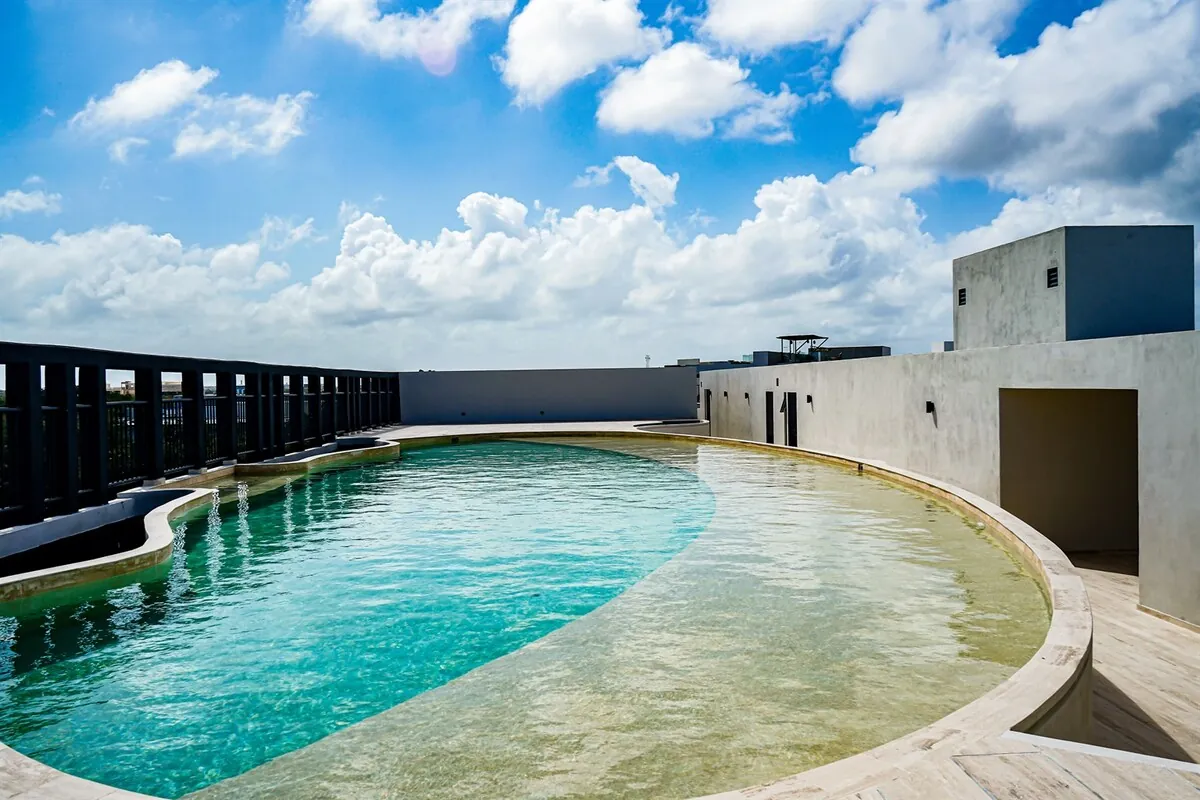
We rent Hacienda Tuk, a two-bedroom, two-bath apartment in downtown Tulum, right on Avenida Cobá. The advantage for this particular trip is simple: you are already on the road you leave by, so you skip twenty minutes of crossing town before you even start. It has a full kitchen, which matters when you want breakfast at 5:45 a.m. and nothing is open, and again when you get back and want something light instead of hunting for a restaurant at eight at night, exhausted. There is a pool and a rooftop, which is exactly what you want after five hours in the sun.
Two separate bedrooms also help if you are two couples or traveling with kids, because somebody is going to want a nap the second you walk in. If you are still comparing neighborhoods, our guide on where to stay in Tulum compares downtown, the beach road and the highway with real travel times.
So, is it worth it?
It is worth it if this is your first time on the peninsula, if you leave early, and if you accept that you are spending five hours on the road to see something you have already seen in a thousand photos and that still lands in person. The scale of El Castillo, the ball court and the observatory does not come through in an image.
It is not worth it if you are short on days, if you are traveling with small kids who wilt in the heat, if you end up going on a Sunday by accident, or if all you want is a pyramid photo. In any of those cases, Cobá is 45 minutes away, costs a third as much, and lets you climb.
Frequently Asked Questions
How long does it take to get from Tulum to Chichén Itzá?
It is about 150 kilometers (93 miles) via Tulum-Cobá-Chemax-Valladolid-Pisté. Driving takes 2 to 2.5 hours without stops. The direct ADO bus runs about 2 hours 20 minutes. Door to door from downtown Tulum and back, plan on 10 to 12 hours.
How much does Chichén Itzá cost in 2026?
Since April 27, 2026 there is a single ticket, the Boleto Único INAH-AAFY: 697 MXN for foreign visitors and 310 MXN for Mexicans and foreign residents of Mexico. Yucatán residents with state ID enter free through 2026, and Sundays are free for Mexicans and residents. Parking for a private car is 124 MXN extra.
What time does Chichén Itzá open, and when is last entry?
Current hours are 8:00 a.m. to 4:00 p.m., with last entry at 3:00 p.m. Some agency sites still advertise a 5:00 p.m. close, so confirm on the day you go. Aim to be inside between 8:00 and 9:00, before the Cancún coaches arrive and before the heat peaks.
Can I take the Maya Train from Tulum to Chichén Itzá?
Not practically. The Chichén Itzá station is in Pisté, about 3 km from the entrance, but there is no direct run from Tulum and you have to transfer. With current timetables you would reach Pisté after the site has closed, so it does not work as a day trip. For this trip a rental car, a tour or the ADO bus all beat the train.
Chichén Itzá or Cobá if I can only do one?
First time on the peninsula and you want the headline site? Go to Chichén Itzá and leave early. Short on days, traveling with kids, or you want to climb a pyramid? Go to Cobá. It is 45 minutes from downtown Tulum, entry costs about a third as much, and the Nohoch Mul climb reopened in December 2025, running 8:00 a.m. to 3:30 p.m. in groups of fifteen.
Is a guided tour better than going on my own?
Tours are convenient and bundle a guide, a cenote and lunch, but they leave Tulum between 8:20 and 8:50 a.m., which puts you at the ruins around 11:00 in full heat and full crowds. With a rental car you can be at the gate at 8:00, and that timing is the real difference between a great day and an average one. If there are only two of you and nobody wants to drive back after dark, the tour makes sense.