📍 Sargassum status — September 2026 (updated September 14)
The season is already on the way down. The University of South Florida's optical oceanography lab, which tracks the Atlantic by satellite, reported in its September 2026 bulletin that total sargassum kept declining in every region, and expects it to keep dropping month after month until around November.
The fine print: except in the east Atlantic, the amount was still above the 75th percentile of historical records, so beaching events continued through August. For your trip that means September and October are transition months — better than June or July, worse than December — and November should be clean beach again.
Landings change day to day and beach to beach: check a same-day report before you pick a beach (we explain how below) and keep a plan B — cenotes, the pool and Bacalar never get sargassum.
What Sargassum Is and Why It Ends Up on the Quintana Roo Coast
Sargassum is a brown seaweed that floats in huge mats across the Atlantic and, pushed by currents and winds, ends up washing ashore on the beaches of the Mexican Caribbean, including the Tulum coastline. It's not a new phenomenon or a one-bad-year fluke: it has been happening seasonally for more than a decade, with big swings from year to year depending on sea temperature and current patterns in the Atlantic.
When it arrives in moderate amounts, some hotels and beach clubs clear it daily and you barely notice it. When it arrives in large amounts, it covers the sand and the water near the shoreline, and as it decomposes it gives off a strong smell. The good news is that it's predictable by season, and Tulum has real alternatives that don't depend on the ocean at all.
When Sargassum Season Is Worst in Tulum
The general pattern in the Mexican Caribbean shows more sargassum between April and August, with May, June, and July the months most prone to big landings. November through February is usually the cleanest stretch, with March and September-October as transition months. This is a pattern, not a fixed rule: some years bring heavy sargassum in the middle of winter and others see very little in summer, so treat it as a reference, not a certainty.
Typical Month-by-Month Calendar
| Month | Typical level | What to do |
|---|---|---|
| January | Low | Good bet for beach days |
| February | Low | Good bet for beach days |
| March | Low-moderate | Check reports before you go |
| April | Moderate | Starting to climb, have a plan B |
| May | High | Make cenotes your main plan |
| June | High | One of the most affected months |
| July | High | Typical peak of the season |
| August | High-moderate | Can still be significant |
| September | Moderate | Improving, hurricane season |
| October | Moderate-low | Improving |
| November | Low | Good bet for beach days |
| December | Low | High season, beaches usually clean |
Which Tulum Beaches Get Hit Hardest (and Which Don't)
There's no Tulum beach with an absolute guarantee of staying sargassum-free year-round: the amount depends on that day's wind and current, not just the season. That said, there are real differences between stretches: some beach clubs and hotel-zone hotels rake the sand by hand every morning, so their section can look spotless even when the public stretch next door has more buildup. Other stretches, more exposed to the current, consistently take in more volume during peak months.
The most honest way to decide is to check recent photos, not generic promises. Many beach clubs post the state of their beach on social media almost daily during peak sargassum season, and that tends to be more reliable than any fixed list of "the best sargassum-free beaches."
How to Check Up-to-Date Sargassum Reports Before Your Trip
Before assuming you'll get a clean beach (or a dirty one), it's worth checking recent information. These are the most useful sources:
- Sargassum Monitoring Network (Quintana Roo): the state government publishes zone-by-zone reports with updated landing levels.
- Satellite imagery (Sargassum Watch System): shows the sargassum bloom in the Caribbean several days in advance, useful for anticipating general trends.
- Social media: look for recent geotagged posts from Tulum beaches; they're usually more current than any blog.
- Ask your host directly: the day you arrive, your host or hotel can tell you the actual state of the beach that week.
No single source is perfect because sargassum changes from one day to the next, but cross-checking two or three gives you a pretty reliable picture before you build your itinerary.
Alternatives When There's Sargassum on the Beach: Cenotes Near Tulum
Tulum's edge over other beach destinations is that it has an excellent plan B just minutes away: the cenotes. They're freshwater pools, underground or semi-open, with zero connection to the dynamics of marine sargassum. No matter what's washing up on the coast, the water in a cenote stays just as clear.
- Gran Cenote: the most visited, with snorkeling, shallow caverns, and plenty of aquatic life.
- Cenote Calavera: small, with jumping spots and a more laid-back vibe.
- Dos Ojos: one of the longest flooded cave systems in the world, great for diving and snorkeling.
You can find hours, prices, and how to get to each one in our guide to the best cenotes near Tulum.
Kaan Luum Lagoon: The Lesser-Known Option
About 20 minutes from downtown Tulum is Kaan Luum Lagoon, a freshwater lagoon that's shallow around the edges with a central sinkhole more than 60 meters (about 200 feet) deep, marked off with buoys. It's calm, has a wooden pier, and usually draws fewer people than the famous cenotes. And since it's freshwater, there's no sargassum here either.
Bacalar, the Lagoon of Seven Colors, as a Day-Trip Escape
If sargassum wrecks several beach days in a row, a trip to Bacalar is a good way to make the most of your vacation. It's a freshwater lagoon with shades of blue that shift with the depth, located about 2.5-3 hours from Tulum by road. It's not a half-day plan, but it works very well as a full-day trip by car, organized tour, or shared transport. Details on how to get there, what to do, and where to stop along the way are in our guide to Bacalar from Tulum.
How to Reach Cenotes and Bacalar Without Your Own Car
You don't need a rental car to pull off plan B. For nearby cenotes, InDrive is usually the most practical and affordable option: you request the ride from the app, agree on the price with the driver before getting in, and skip the typical street-taxi haggling. For longer runs toward Cobá or in the direction of Bacalar, the colectivos (shared vans) that leave from downtown, near spots like the Super Aki, are a budget-friendly alternative, although for Bacalar in a single day, an organized tour or private transport is usually the most comfortable choice given the distance.
Where to Stay So You Have a Real Plan B
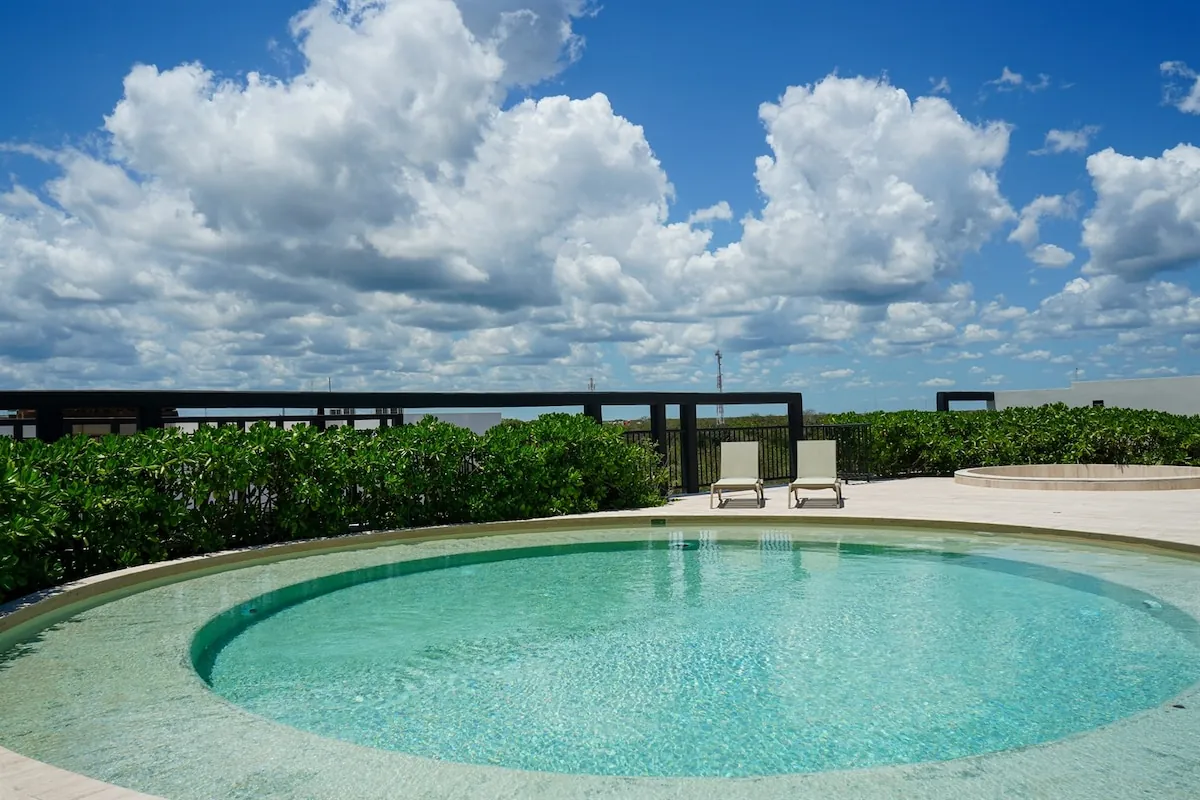
The simplest way to stop depending on the weather or the sargassum is having your own pool where you're staying. The two-bedroom boutique apartment with a private pool in downtown Tulum works exactly like that: if the beach doesn't cooperate one day, you swim at home without losing the day, and you're still close to the cenotes and downtown so you can pivot fast to whichever plan B you prefer. It also has Wi-Fi, handy if you want to check up-to-date sargassum reports or knock out some remote work between activities, and you book directly, with no middlemen.
The Bottom Line
Sargassum in Tulum is real, seasonal, and variable: generally worst between April and August, calmer from November through February, but never 100% predictable a year in advance. The best strategy isn't avoiding Tulum in certain months, it's arriving with a plan B ready: recent reports before picking the day's beach, cenotes and freshwater lagoons always on standby, and a place with a private pool as backup for when the ocean isn't cooperating.
Frequently Asked Questions
When is sargassum season worst in Tulum?
The typical pattern shows more sargassum between April and August, with frequent peaks in May, June, and July. November through February tends to be the cleanest stretch. That said, every year varies with currents and winds, so treat these months as a general reference, not a guarantee.
Are there beaches in Tulum without sargassum?
No beach is 100% guaranteed clean year-round. Some beach clubs rake the sand by hand every morning, so their stretch can look great even when the beach next door doesn't. The amount changes day to day with the wind, so it's worth checking recent reports or photos before heading out.
Are cenotes affected by sargassum?
No. Sargassum is a marine algae that drifts onto the Caribbean coast with the current, but cenotes are inland freshwater pools with no connection to any of that. That's why they're the most reliable plan B in Tulum when the ocean won't cooperate.
Where can I check an up-to-date sargassum report?
The Quintana Roo government's Sargassum Monitoring Network publishes beach-by-beach reports, and the Sargassum Watch System (satellite imagery) shows the bloom in the Caribbean days in advance. It also helps to look up recent tourist photos on social media or ask your host directly the day you arrive.
What do I do if I get to Tulum and the beach is covered in sargassum?
Switch up the day's plan without drama: head to a nearby cenote, to Kaan Luum Lagoon, or consider a day trip to Bacalar. If your place has a private pool, that's the simplest fix while the ocean clears up, which usually takes just a few days with favorable wind.